General information only. ASME A13.1 is a voluntary standard unless your contract, owner or jurisdiction requires it. Get the current edition for exact requirements such as letter heights and marker sizes.
The idea: name the contents, show the flow
A pipe marker tells anyone nearby what is inside the pipe and which way it flows. ASME A13.1 asks for a short, clear legend (for example "HOT WATER" or "NATURAL GAS"), with extra details such as pressure or temperature where needed to identify the hazard, plus arrows showing flow direction (double arrows when flow can go both ways).
Colors
The legend's background and text colors indicate the type of hazard (for example white on red for fire protection, black on yellow for flammable fluids). The full list is in the valve tag and pipe marker color code guide.
Where markers usually go
Commonly cited locations include next to valves and flanges, at changes of direction, on both sides of walls and floors the pipe passes through, and at intervals along long straight runs. Markers should be readable from the normal approach, so on overhead pipes they usually sit below the centerline.
Where valve tags fit in
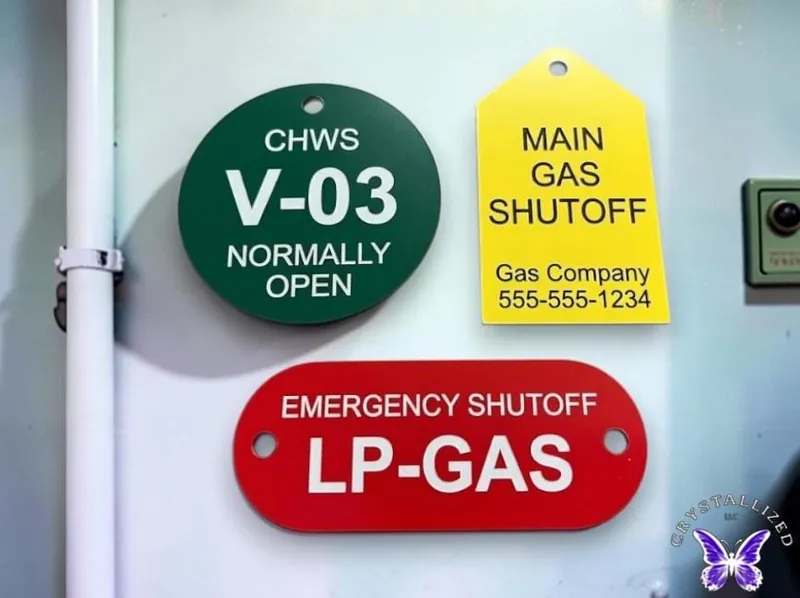
Small pipes and individual valves are often identified with valve tags instead of wrap-around markers. A tag carries a number and short description that matches a valve chart listing every valve, its location and what it controls. CRYSTALLIZED engraves valve tags (round, oval and gable, with chains and numbered runs); it does not make wrap-around pipe markers. See valve tags and plumbing tags.
Practical tips
- Write your legend list and valve chart before ordering anything.
- Use the same words on markers, tags and the chart.
- Choose durable engraved tags in hot or dirty mechanical rooms.
Order tags in the Label Designer, or ask Crystal about a large job.